Social Justice and Inclusion
Foundational Outcomes Achieved:
-
Understand how one is affected by and participates in maintaining systems of oppression, privilege, and power.
-
Engage in critical reflection to identify one’s own prejudices and biases.
-
Participate in activities that assess and complicate one’s understanding of inclusion, oppression, privilege, and power
-
Connect and build meaningful relationships with others while recognizing the multiple, intersecting identities, perspectives, and developmental differences people hold
-
Articulate a foundational knowledge understanding of social justice and inclusion within the context of higher education
How did I achieve these foundational outcomes?
Pursuing Learning Different Cultures and Cultural Understanding
-
I received a certificate in Intercultural Competence after completing three sessions that explored a range of student experiences and identities across campus. Each session focused on a different population, including students with disabilities, international students, and students from diverse cultural backgrounds, which helped me better understand how identity and lived experience shape the way students navigate higher education.
-
Through these discussions and activities, I was able to reflect on my own assumptions, learn more intentional ways to support students, and think critically about how institutions can be more inclusive in both policy and practice. Overall, the experience strengthened my ability to engage with students in a more thoughtful, culturally responsive way and reinforced the importance of continuing to grow in intercultural awareness as a future higher education professional.
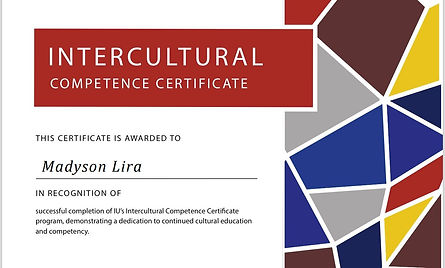
Intercultural Competence Certificate
Creating Cultural Events and Partnerships
-
I created an event called the Cultural Language Exchange Workshop, where I designed opportunities for students to engage with and learn about a variety of languages, with a particular emphasis on languages commonly spoken within our international student population. The goal of the workshop was to make language learning approachable and interactive, so students could build basic familiarity with everyday phrases in a welcoming, low-pressure environment. I incorporated hands-on activities like matching games and collaborative exercises where students connected words and meanings across different languages. This helped create a fun and engaging space while also encouraging cultural curiosity, peer learning, and appreciation for linguistic diversity on campus.
-
In addition, I developed a partnership with the First Nations Cultural Center to support programming during Indigenous Peoples Month. Through this collaboration, we helped fund books for a joint book club between the First Nations Cultural Center and the LGBTQ+ Cultural Center, which focused on exploring intersecting identities and shared experiences across communities. We also supported a visit from a Native American artist by providing lunch for the event, where the artist discussed Indigenous art forms and led an interactive activity for students to create artwork inspired by Indigenous methods and traditions. These initiatives helped foster cross-cultural dialogue, celebrate Indigenous voices, and create intentional spaces for learning, reflection, and community building across identity-based cultural centers.

Language Exchange Workshop
Uncomfortable Conversations
-
During my time at Brown University, I served on the conduct team, where I supported the adjudication of student conduct cases involving violations of the student code of conduct. In this role, I met individually with students to discuss their behavior, better understand the circumstances surrounding each case, and collaboratively develop appropriate consequences and action plans for moving forward. These conversations required me to balance accountability with education, ensuring students not only understood the impact of their actions but also had a clear pathway for growth and behavioral change.
-
During that summer, we also saw an increase in cases involving racist and harmful language directed toward other students, which was a significant learning curve for me, as I had not previously encountered this level of conduct concerns in my prior leadership roles. In response, I had to engage in deeper reflection around students’ biases and perspectives while also recognizing when and how to challenge harmful beliefs directly. My approach focused on holding students accountable while also trying to understand the context behind their actions to turn those moments into meaningful learning opportunities. In addition to individual conduct meetings, our team also developed educational programming and facilitated group conversations addressing the impact of harmful language and behavior within the community. These experiences pushed me to grow significantly in my ability to navigate difficult conversations, uphold community standards, and contribute to a campus environment centered on respect, accountability, and learning.