Leadership
Foundational Outcomes Achieved:
-
Identify and understand individual-level constructs of “leader” and “leadership.”
-
Explain the values and processes that lead to organizational improvement
-
Identify institutional traditions, mores, and organizational structures (e.g., hierarchy, networks, governing groups, technological resources, nature of power, policies, goals, agendas, and resource allocation processes) and how they influence others to act in the organization.
-
Identify one’s own strengths and challenges as a leader and seek opportunities to develop leadership skills.
-
Identify fundamentals of teamwork and teambuilding in one’s work setting and communities of practice.
-
Describe how one’s personal values, beliefs, histories, and perspectives inform one’s view of oneself as an effective leader with and without roles of authority.
-
Understand campus cultures (e.g., academic, student, professorial, administrative) and apply that understanding to one’s work.
-
Use appropriate technology to support leadership processes (e.g., seeking input or
feedback, sharing decisions, posting data that supports decisions, using group support website tools). -
Identify and consult with key stakeholders and individuals with differing perspectives to make informed decisions.
How did I achieve these foundational outcomes?
Teamwork and Teambuilding in Practice
-
I developed my understanding of effective teamwork through supervising student staff, collaborating with campus partners on programming initiatives, and working within multiple-layered teams across different institutional contexts. In my role at Brown, I supervised a team of student staff while also functioning as part of a broader professional team that included Area Coordinators, Housing Coordinators, and Programming Coordinators. This dual experience helped me understand teamwork from both a supervisory and peer-to-peer perspective. Within the professional staff team, I learned the importance of relying on one another’s expertise, especially when responsibilities overlapped or when student needs required coordination across roles. We regularly leaned on each other’s strengths and institutional connections to ensure that students were receiving a cohesive and consistent experience in the residence halls.
-
At the same time, in my supervision of student staff, I worked intentionally to build a team culture rooted in trust, clarity, and shared responsibility. I prioritized setting clear expectations while also creating space for student leaders to bring forward ideas, challenges, and feedback. I learned that effective team development requires ongoing communication and structured reflection, not just task completion. By balancing accountability with support, I helped foster a team environment where students felt both challenged and valued in their roles.
-
Additionally, my experience as President of the Student Personnel Association further strengthened my ability to lead and contribute within complex team structures. In this role, I worked closely with the Vice President and Directors to coordinate initiatives, support individual portfolio goals, and ensure alignment across the organization. I saw firsthand how leadership in a student organization depends on collaboration across roles rather than siloed efforts. My role required me to facilitate communication, support peers in their responsibilities, and help maintain a shared vision for the organization’s success. Across these experiences, I learned that strong teams are built through trust, interdependence, and consistent communication, and that effective teamwork requires both leading and actively participating within a collective structure.


Student Personnel Association Monthly Meeting
Brown South Campus Area Coordinator Team
Understanding of Leadership (Individual-Level Constructs of Leader & Leadership)
-
I developed my understanding of leadership as a relational and developmental process through my experiences in orientation, residence life, student supervision, and campus leadership roles. Rather than viewing leadership as tied to position or authority, I came to see it as the ability to influence, support, and empower others toward shared goals. In my work with student staff, I often found myself in informal leadership roles where I was guiding reflection, modeling expectations, and helping students navigate ambiguity in real time. These experiences helped me clarify my leadership identity as someone who prioritizes care, accountability, and collaboration over hierarchy.
-
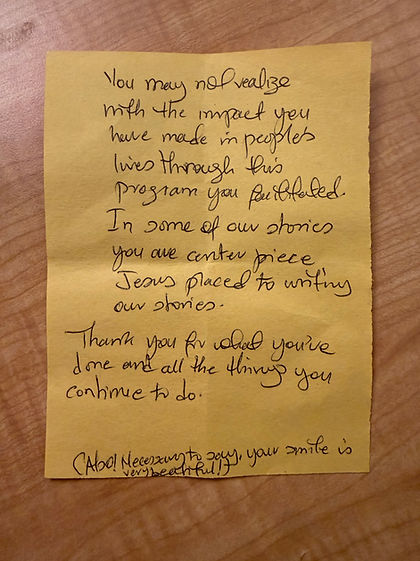
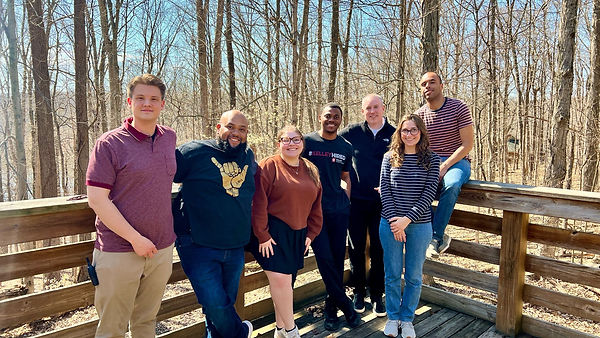
My understanding of leadership was further shaped through my role as the Onsite Graduate Assistant for LeaderShape, where I facilitated leadership development by providing mentorship and programmatic support throughout an immersive leadership experience. In this role, I supported participants and facilitators in engaging deeply with the curriculum, while also helping maintain the intentional environment needed for reflection and growth. Being present in that space reinforced for me that leadership development is not about delivering content, but about fostering trust, presence, and meaningful challenge that allows individuals to explore their values and leadership identities.
-
Additionally, serving as Director of Graduate Affairs within the Indiana University Student Government significantly deepened my understanding of leadership in institutional and advocacy contexts. In this role, I was regularly in meetings with university administrators where I advocated directly for graduate student needs, perspectives, and structural concerns. I learned how to navigate complex institutional systems while ensuring graduate student voices were included in decision-making processes that often overlooked or minimized their experiences. My advocacy also extended beyond campus through participation in a Capitol Hill advocacy trip, where I engaged with lawmakers to discuss the professional degree classification and the importance of sustained graduate student funding. These experiences highlighted for me how leadership requires both interpersonal influence and systems-level advocacy, especially when representing populations that are often underrepresented in higher education policy conversations. This perspective was further reinforced through academic work, including a paper I wrote on the importance of graduate students in majority undergraduate spaces and the ways their contributions are frequently unrecognized despite their central role in teaching, mentoring, and institutional functioning.
-
Across these experiences, I have come to understand leadership as an ongoing practice of relationship-building, reflection, and shared responsibility that extends from individual interactions to institutional and policy-level advocacy.


Trip to Capitol Hill

Leadershape Notes and Team